
High-Quality vs. Low-Quality Academics
Hey Folks -
As I was writing about the 8 Markers of a Quality Kindergarten Program, I realized I kept coming back to this thought about the difference between high-quality and low-quality academics.
Over the course of my teaching career, there has been a steady movement towards increasing “instructional time.” Recess time has been getting shorter and shorter to make space for “academics.” I even taught Kindergarten at a school that told me, “there’s no time for play.”
….Yeah, that job didn’t work out for me.
Now there is (rightfully) a backlash against slimming down playtime. Parents are onboard with kids playing and are demanding play at school. In light of this, academics and rigor have become dirty words.
But, there is more going on here than a fight between play vs. academics. What folks are bristling against is too much time spent on low-quality academics.
High-Quality vs. Low-Quality Academics
High-quality academics inspire kids to feel hopeful about the future, to feel in charge of their lives and capable. It builds agency and an ability to understand the world and themselves, and to be able to use that information to do something about it–to make themselves better, to make the world better.
High-quality academics allow kids to celebrate the wonderful things there are in life. It shows kids how beautiful life is, how curious and how tricky things can be, and that that’s okay.
High-quality academics take skilled teachers to implement. It’s an art and requires a deep love of learning and curiosity about the world.
Low-quality academics, on the other hand, require a lot less training and expertise. Outcomes are also a lot easier to measure. This is why a lot of schools decide to go in this direction.
Unfortunately, we live in a country that does not value training teachers and funding education.
“Those who can, do; those who can’t, teach.”
The ultimate insult to those of us who are truly passionate about teaching and educating our youth. Sayings like this make us think that teaching is easy, and lowers our standards for the teaching profession.
With low-quality academics there are a lot of worksheets with yes or no answers. That’s because it’s really easy to grade them and put a score on it. Then we have data to make some sort of judgement or statement about what’s happening in that school or classroom or with that child.
But those data points don't display the full picture, and they often aren't even measuring what we think is important in a child's education.
When assessing children engaged in high-quality academics, it provides a much more nuanced profile of your child. Because of this it requires people who know what they're doing to be observing the growth in your child. These teachers have to really know each child and understand what kind of learning journey they’re on; where they started and where they’re going.
That requires experts, it requires time, and it requires money, because these teachers have to be highly trained. And they need to be given the time to be able to plan, observe and understand each child.
Let’s get into some concrete examples
Take a moment to observe a unit on data collection and graphing in 1st grade and see how we might approach it in a low-quality and high-quality way. It's not lost on me that I was just discussing data collection by teachers in the classroom. Let's see how we can instill the importance of this task in children.
Low-Quality Graphing Unit
In this unit, kids will be exposed to some different types of graphs: bar graphs, line plots, pictographs. They might collect data on a few relevant topics like favorite colors in the class. This is fun, and the kids love it!
Most of the time, kids will move through worksheets that look like this:
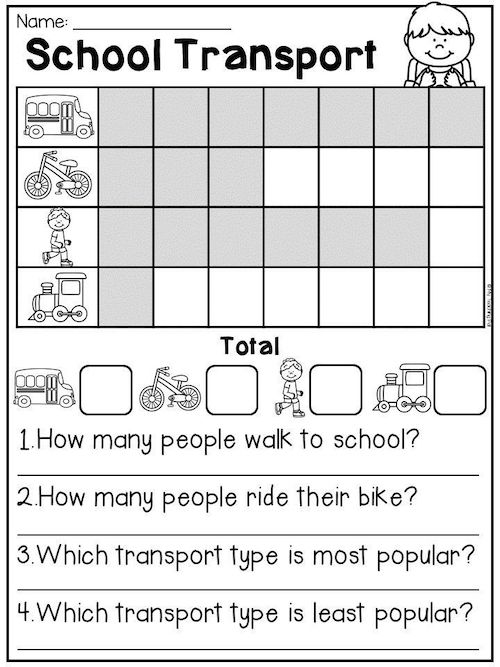
Often data collection and graphing is seen as a breezy, fun unit without much rigor to it. But isn’t interpreting and analyzing data really important? Don’t we want kids to learn how to think critically about the data they collect and take action when needed?
High-Quality Graphing Unit
In this unit, kids will work with a variety of real-world objects and experiment with different ways of displaying the information they found. First, they are given collections of shells, and asked to notice the differences between each shell. They learn that these differences are called attributes, and they get to sort the shells based on whatever attributes they find interesting. They learn how to break similar items into categories and make names for those categories.
After this, it’s time to play around with different ways to display the data they collected. We explore different types of graphs and also leave space for kids to display the information in new ways they create. The goal is to communicate with others the information held within their collection.
After creating their data displays, kids go through a “gallery walk” and explore everyone’s data collections. They are exposed to new ideas by their peers about how to display information. This is something the scientific community values deeply, and kids can go through that process too.
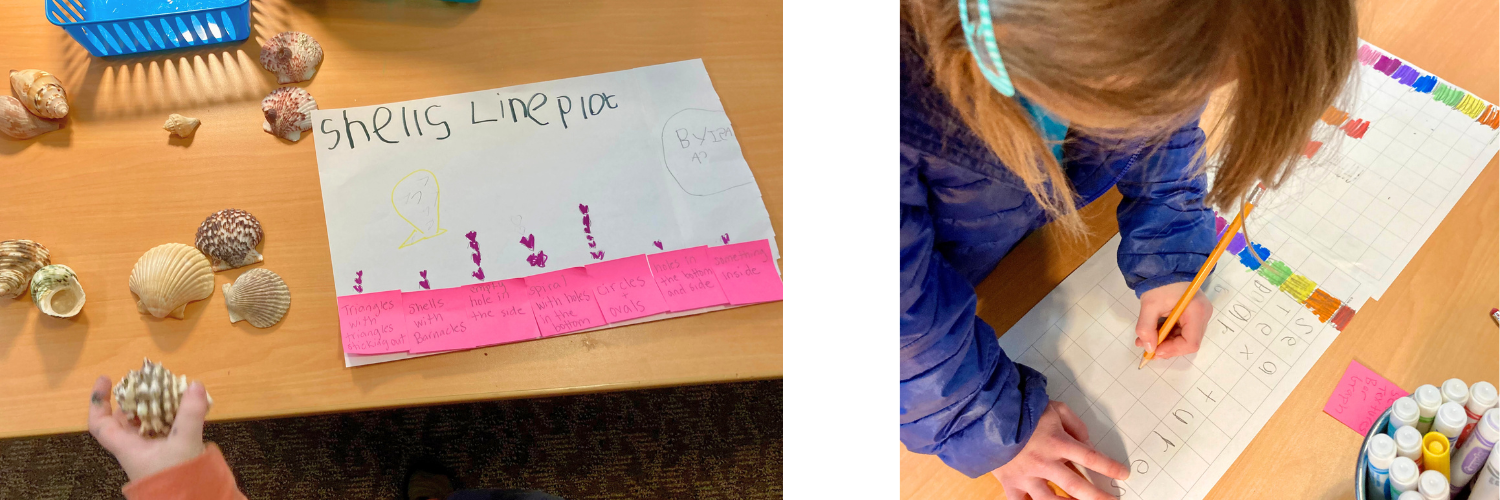
The final part of this unit is for the class to collect and analyze data so they can take action on something. This is the most authentic experience in the unit with data collection, and something adults do in many professions.
Kids are tasked with thinking about the recycling we create at school. They work together to make sense of what we’re throwing away, and if there is anything we could have reused instead. They sort the recycling based on attributes (that’s new vocabulary they’re using!) and display their data in a way that communicates the information to others.
After this, they take action on what they learned from their data collection. Maybe they realize how much paper they’re throwing away when they cut a tiny circle out of the middle of a piece of paper and decide the rest is unusable. Maybe they’ll educate each other on cutting circles at the edge of the paper and using one piece of paper for more than one cutting project. (A teacher can dream!)
It doesn’t really matter what they decide to take action on. The point is they are learning how to USE data. They are asking questions, wondering, taking action and being in charge of understanding themselves and their world a little better.
That is high-quality academics. That is the kind of work that inspires kids and teaches real skills, not just filling in easy answers.